Tuesday, March 12, 2013

The Probate File of Henry Lambert, Pt 3

Continuing with the probate of Henry Donham Lee Lambert's estate in Oklahoma County Court, in July 1919 the court ordered the sale of Henry's 160 acres. Matilda objected to the private sale of the land, and asked the court to direct the land be sold by public sale, so as to get a better price. The court agreed.
On 6 September 1919, the property sold for $7150.00, above the appraised value of $4500. The buyer was Drusilla Burrows.
I'm building up to Matilda's letter, which will appear in Part 4.

The Probate File of Henry Lambert, Pt 2

Following my earlier post of the probate file of Henry Donham Lee Lambert in Oklahoma County Court, I looked ahead through the rest of the file. It contains about 250 images, some are the front and back of checks paid to the Lambert beneficiaries. It is a wonderful find, and includes a handwritten letter from my 2nd-great-grandmother Matilda Jane Lambert in Illinois to the court in Oklahoma. This gives a whole new insight into her personality, which I did not have before.

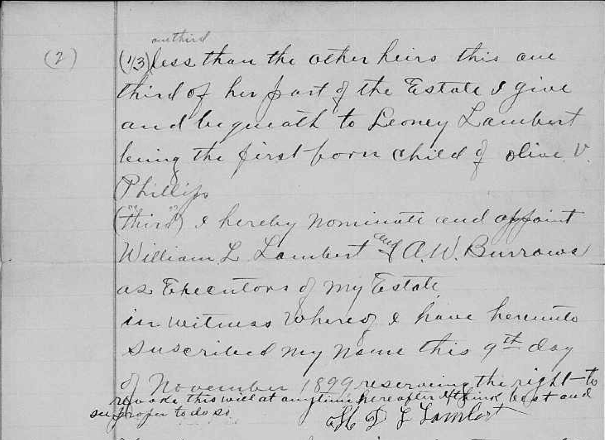
The Will - 9 November 1899
Henry died in March 1909, either on 20 or 22 March. Cordelia Lambert passed away on 28 November 1918, triggering the probate of Henry's estate in December 1918. Henry listed his remaining heirs as:
1. Eva Emeline (Lambert) Wilson
2. Matilda Jane (Lambert) O'Brien
3. William L. Lambert
4. Mary Alice (Lambert) Cunningham
5. Olive V. (Lambert) Phillips
6. Drusilla (Hensley) Burrows

Henry also stated that Olive was to give 1/3 of her part of the estate to her first born, Leoney Lambert. Olive was the first born daughter of Henry and Cordelia Lambert, who also had a son, Elmer Lambert.

The executors were William Lambert and A. W. Burrows. William passed away on 4 December 1911, so his executor duties fell to Burrows. William's portion of the estate would be divided among his wife and children.

A. W. (Arthur) Burrows was the husband of Drusilla Hensley Burrows, daughter of Cordelia from her first marriage, making her Matilda's step-sister. It took a little time to see how Drusilla fit into the family until I looked back at Cordelia and her first marriage to Samuel Hensley in Illinois.

Burrows filed a motion with the court to sell Henry's property in order to pay the creditors and beneficiaries under the will. Henry's property, consisting of 160 acres in Oklahoma County from the original land grant, was appraised at $4,500. He also had a mule.

Matilda filed an objection to the sale of Henry's property at private sale, as she thought the appraised value of the property was lower than what it could be sold for at a public sale. Her letter is worth its own post, so I will share it next.

The Probate File of Henry Lambert, Part 1

Back in October 2012, I posted photos of the tombstones for my third-great-grandfather Henry Donham Lee Lambert and his second wife, Cordelia Lambert. Henry had settled in Luther, Oklahoma County, Oklahoma, before passing in March 1909. After poking around in the FamilySearch Oklahoma Probate Files, I found Henry's probate record. It is a big file and will take a few days to sort through. The file begins on Image 608 of 949 in the Probate Case Files for 1918, packet number 3629, filed 13 December 1918 in Oklahoma County Court.

I had wondered if my 2nd-great-grandmother Matilda Jane Lambert ever saw her father again after he moved west to Oklahoma before 1880. She must have stayed in contact with him. Matilda is listed as an heir, living in Shelbyville, Illinois, on the second page of the probate file.
Henry's will was written on 9 November 1899. I'll have a separate post on the will to follow. Matilda was provided notice of the hearing to probate the will in Oklahoma.
Further review of the file shows that notice did reach Matilda, and she moved to object to the sale of Henry's property by private sale in August 1919.

Sunday, March 10, 2013

A Return to the Blog

I'm back in the US after participating in a workshop and meetings in Addis Ababa, Ethiopia. This was not my first visit to the continent, as I've previously been in Morocco, Egypt, Senegal and Tunisia. Each experience to Africa has been different. On this trip I saw little beyond the drive from the airport to the hotel and the offices at the United Nations Economic Commission for Africa (UNECA).

It is unfortunate that there was not time to see more. Addis Ababa appears to be a city on the rise, or least the area around UNECA is under major construction in preparation for the 50th anniversary of the founding of the African Union. But, even without seeing the city, I did have the opportunity to meet some great people. Establishing relationships and connections with people was more important than seeing a place. That goal was met, and I look forward to continuing conversations with these people in the future ahead.

A major document was released during the week, so I may now have some spare brain cycles to return to the blog. There are a few threads that I want to explore before heading out to Rootstech in a few weeks. I don't have a lot of ambitious writing goals for the month. Perhaps returning to daily writing itself should be the goal, and the stories will unfold from there.

Sunday, March 3, 2013

Welcome to March

It's tough to get back in the habit of regular blogging when you take a break. February was a busy month. I have been writing, just not so much on the family history. I have a big document to be released soon, and will be on the road in Ethiopia.

March did bring some surprise news - the 1993 Wabash College Swim Team is being inducted with 8 other teams as part of the first slate of teams to be included in the Wabash College Athletics Hall of Fame. I was very lucky to swim with such an outstanding group, for a Hall of Fame coach. The induction will be over Homecoming Weekend in September. I have a whole set of news clippings and photos from 1992-1996 buried somewhere in a box, so this is a reminder to dig that out later this spring or summer.

If you're headed to Rootstech later in the month, you'll find me on a panel about open standards and FHISO during the Developer Day track. This is the rare opportunity to bridge my worlds of Internet security & governance with family history.