Tuesday, January 20, 2015

John Booher Jr in the War of 1812

Over the weekend, my review of the Booher family records included a dive through the extensive legacy of my 7th-great-grandfather, John Booher Sr. From his will and the story of his youngest daughter, Elizabeth Booher Parragin, we learned the names of his children and their own large families. Since John had eight sons, I was hopeful that I might learn more about them and the Booher family in military records. At least two of the sons served in the War of 1812 - John Jr. and Isaac. These are unique records and once again I am thankful of the effort to digitize the War of 1812 pension files.

John Booher Jr was a brother of my 6th-great-grandfather Jacob Booher. He ended up in Darlington, Montgomery County, Indiana, not far from my undergraduate institution, Wabash College. Booher's pension application, along with his wife Margaret's widow's pension application, were sent from Montgomery County. Seeing this connection to the place where I spent four years provides some extra incentive to look a little closer at the file.

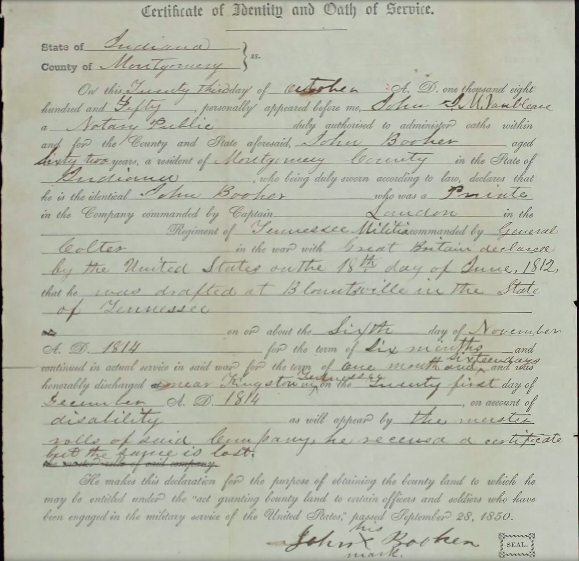
John served in Captain James Landen's Company, 4th Regiment of the East Tennessee Militia. The auditor recorded his name in the file as John Booker, and several of the documents continue this misspelling. He was drafted in Blountsville, Tennessee on 6 November 1814, and served until he was honorably discharged at Kingston, Tennessee on 21 December 1814 for disability. The service record showed that he was paid from 13-27 November. Even though he only served 14 days, Booher applied for bounty land.
Source: Fold3.com, War of 1812 pension file

According to the file, John Booher Jr married Margaret Zimmerlie on 29 June 1813 in Washington County, Virginia. Margaret was the daughter of Jacob Zimmerlie (also spelled Zimmerle and Zimmerly), who helped put up the bond for John Booher Sr's estate in 1820. When John Jr was drafted in November 1814, he had one infant son at home (Benjamin, born in April 1814). Perhaps he did not want to be gone from home long, but his time in the 4th Regiment was short. Upon his return from service, Margaret became pregnant with their second son, Jacob Booher, who was born in September 1815. As noted in Elizabeth Parragin's story, John Jr and Margaret had 13 children, and they eventually moved to Indiana following John's brother Jacob to the fertile lands of Montgomery County.

John Booher Junior died on 19 February 1873 in Montgomery County. The file continues with the widow's pension of Margaret Booher, and contains a detailed family history in an affidavit from her son, Jonathan A. Booher. I will describe that history in the next post.

Monday, January 19, 2015

The Parragin Story

As part of my on-going look into the Booher family line, I have reviewed land and will records in Indiana, Tennessee and Virginia. This has been useful in placing the Booher family in Sullivan County before Tennessee became a state. The will records have also provided context to the Sullivan County land referenced in my 7th-great-grandfather John Booher's will probated in Washington County, Virginia in 1820. But to better understand how the family came to this corner of the country, we need to return to Betty McCay's A History and Genealogy of the Booher Family, 1747-1964. The book contains a transcription of an interview with John Booher's youngest daughter, Elizabeth Booher Parragin. She lived to be 105 years old. Elizabeth's story was collected in October 1901 and read at the Booher Reunion in Montgomery County, Indiana on 3 September 1902.

Source: Library of Congress, Abingdon, Virginia
Source: McCay, pg 9.
The Parragin story has been published in other forms online (see New River Notes but be aware that there are typos with this transcription).  I have extracted out sections of interest, and the full story can be read in McCay's book. It begins at the Booher family reunion in 1900, when the family learned of a relative living in Clinton County, Kentucky who was 104 years old. Eva Booher recounts how she was designated to travel from Indiana to visit Elizabeth Parragin in Kentucky, since she was the only person in Montgomery County who recalled seeing her Aunt before the family moved from Sullivan County to Indiana. Eva wrote that she last saw Elizabeth on 25 August 1833, before her father moved to Indiana, and that she hadn't heard from her in 15 years, and thought she was dead.

Eva traveled with her cousin and her son-in-law to Cincinnati, where they picked up the Cincinnati Southern Railroad to Burnside in south-central Kentucky. From there they took a stage coach 25 miles to Monticello. They spent the night in Monticello and then hired a man who took them over a mountain 25 miles to Albany, Kentucky. "The road was one of the roughest it had ever been my experience to travel and in many places found it much more agreeable to walk than ride. I would call much of the country Godforsaken except for the consideration I have for the dear folks I found at the end of the journey and who must pass this way for 50 miles to get to the railroad which will take them to God's country in Indiana."

Elizabeth Parragin appears in the 1900 US Census in the household of her son, Judge Cyrus Parragin. In the story, the Boohers went to Cyrus' home and interviewed Elizabeth on her family history. "Her voice was clear and her hearing was not seriously impaired."

Elizabeth's Story

"My name is Elizabeth Parrigin and I am the youngest daughter of John Booher. I was born in Sullivan County, Tennessee January 11, 1797, and if I live till my next birthday I will be 105 years old. We moved within 4 miles of Bristol, Tennessee when I was 19 years old from Washington County, Virginia, Abingdon being the county seat. We moved to Clinton County, Kentucky one mile from where we now lived, October 17, 1858. I was married to Henry Parrigin August 18, 1821 at the age of 24 in Washington County, Virginia. We had seven children, 3 daughters and 4 sons: Amelia Ann, John Franklin, Martha Jane, Sabrina, Emery, Cyrus, and William Henry."

"My father, John Booher was of German parentage. My grandfather came from Germany to Pennsylvania but my father and mother were born in this country. My grandparents died when I was a child and my father went back to Pennsylvania when I was about 10 years old to get his legacy. Martin was my father's brother. My father had 10 children, 8 sons and 2 daughters. Their names were: Jacob, Mary (Polly), William, Benjamin, Jehu (died in infancy), John, Frederick, Isaac and Henry (twins), and Elizabeth.

Jacob lived in Tennessee until 1833 when he moved to Indiana and located near Darlington. His children were: William M., Mike, Elizabeth, Gurdianus (Curtis), Samuel, John M., Ambrose, Jonathan M., Jacob Jr., Mahala, Benjamin, Lucinda, Catherine, and Leander.

Mary (Polly) lived in Tennessee and had 13 children, her husband was John Booher and her cousin. The names of the children were: Frankie, Daniel, Rebecca, Peter, Samuel, John, Elias, Jacob and Mary (twins), Barbara, Eli, Elizabeth, and Lydia.

William had 9 children; 3 sons and 6 daughters. He lived and died within 4 miles of Kingsport, Tennessee. The names of the children were: Lucinda, Nancy, John, Adelaine, and Mary (Dolly). One boy died in infancy and the names of the younger girls I can not remember.

Benjamin had 9 children; 4 sons and 5 daughters. He lived and died in Sullivan County, Tennessee. The names of the children were: John, Martin, Katherine, Sarah, James, Nancy, Esther, Leah, and Abraham; at last count only James and Esther were living.

John had 13 children: Benjamin, Jacob, William, Nathaniel, Samuel (died in infancy), Mary, Nathan, Margaret, Isaac, Elkanah, Catherine, Johnathan A., and Sylvanus. He migrated to Indiana.

Frederick lived and died in Virginia; he was the father of seventeen children, nine sons and eight daughters. One son died in infancy but the other children grew to manhood and womanhood. Their names were: Frederich, Samuel, James, John, William, Curtis, Jacob, Benjamin, Eliza Ann, Frankie, Elizabeth, Mary, Rachel, Melinda, Margaret, and Catherine. Joseph died in infancy of whooping cough.

Isaac had 10 children, 6 sons and 4 daughters. He lived and died in Virginia after raising 6 children. Their names were: Macgee, Lydia, Lossin, Susan Catherine, Isaac (died in infancy), three children were born dead.

Henry, when a child just able to walk, fell and bit his tongue in two and never talked plain. He never married but lived to be about 30 years old, and died in Virginia.

Jehu died in infancy.

Elizabeth, that is my name and I have told you about myself.

In conclusion, let me ask how many of us could give array of facts and that without hesitation? Aunt Elizabeth showed us some interesting relics among which was a pair of pothooks made in Tennessee by William Booher, a son of Jacob, and father of Elizabeth Booher (Aunt Bet) who is here today and now has the pothooks, the same being sent to her by Aunt Elizabeth. She also showed us a German Bible 127 years old and a bowl 125 years old which she had received from her mother.

But the saddest of my story is yet to be told, for since our visit to Grandmammy she was summoned to another world and today is no more among the living on earth. She died April 13, 1902 at four o'clock in the afternoon and was buried the next afternoon at three o'clock at the Springs Cemetery near her last home.

Her exact age at time of her death was one hundred five years, three months, and two days.
END OF PARRIGIN STORY,
WRITTEN BY:
STRANGE N. CRAGUN
LEBANON, INDIANA
--
Back in the Census records, Elizabeth Booher Parragin and her family appear in the 1850 US Census in Washington County, Virginia.

Though the story is short, it provides an invaluable recollection of family history. From the interview with Elizabeth, it appears my 6th-great-grandfather Jacob moved in the summer of 1833 to Indiana. We know from the land records that Jacob sold the last of his land in Sullivan County in August 1834. From the story, Jacob was also the oldest son of John Booher Sr. Elizabeth's description of Henry Booher, twin of Isaac Booher, helps understand why John Sr asked Isaac to serve as guardian for his brother in the will, and to maintain the land in Washington County for Henry.

There is more to follow before turning to the Hampton family. John Booher Jr and Isaac Booher served in the War of 1812, and there are pension files for both on Fold3.

Sunday, January 18, 2015

The Will of John Booher

In looking at the Sullivan County, Tennessee land records (see yesterday's post), the deeds show my 7th-great-grandfather John Booher was a large land owner on Sinking Creek. John's will, written 26 November 1820 and proven on 10 December 1820 in neighboring Washington County, Virginia, describes his land in Tennessee. The will also includes two other familiar names as witnesses - George Burkhart and Wallace Willoughby. Both men were regularly involved in land transactions with John's son Jacob Booher.

This is a transcription from the will:

In the name of God Amen, I John Booher of Washington County, State of Virginia, being weak and sick in body, but of sound and disposing mind, memory and understanding, considering the certainty of death, and the uncertainty of the time thereof, and being desirous to settle my worldly affairs, do therefore make and publish this my last will and testament and form following that is to say:

First and principally, I commit my spirit unto the hands of the Almighty God, and my body to the earth. After my just debts and funeral charges are paid, I devise and bequeath the following:

Item First: I give and bequeath unto my beloved wife Barbara Booher during her natural life the tract of land whereon I now live with the appurtenances thereunto belonging, and at my wife's decease it is my desire that my son Isaac Booher shall have the above tract of land with all appurtenances thereunto belonging to him or his heirs, it is my further desire that my son Isaac Booher shall maintain my son Henry Booher during his natural life, and further desire that said tract of land shall not be sold during my son Henry's life.

Item: I give and bequeath unto my beloved wife, Barbara Booher, my negro woman Polly, also her child Celia and her infant child during her natural life. It is also my desire that my wife shall have choice of two horses also two cows and one heifer also choice of four sheep and one breeding sow - it is further my desire for my wife to keep all my household and kitchen furniture.

It is my further desire for my wife to keep all my grain now on hand either growing or gathered, and at her decease, it is my desire that all the moveable property and also the three aforesaid negroes with their increase shall be sold at public sale on a credit of twelve months and the profits arising from said sale to be equally divided amongst all my children.

Item: I give and bequeath unto my son Henry Booher my negro boy Jefferson, and it is my desire that my son Isaac shall act as guardian for my son Henry and apply the proceeds of said negro boy for the benefit of my son Henry.

Item: I give and bequeath unto my son Isaac Booher him and his heirs the aforesaid tract of land at my wife's decease with the appurtenances thereunto belonging.

Item: I give and bequeath unto my daughter Elizabeth Booher, my negro girl Teressa. Also my bay mare called Phillis provided she marries consentably to her mother.

Item: It is further my desire that all lands in Sullivan County, State of Tennessee, shall be sold twelve months after my decease, to the best advantage by my Executors hereafter mentioned and the money arising therefrom to be equally divided between Jacob Booher, Polly Booher, wife of John Booher, William Booher, Benjamin Booher, John Booher and Frederick Booher, them and their heirs.

And lastly I do hereby constitute and appoint my son Jacob Booher and my son Benjamin Booher to be the sole Executors of this my last will and testament. In testimony whereof I have hereunto set my hand and affix my seal this 26th day of November 1820. John Booher {seal}

Signed, sealed, published and declared by John Booher Sr. the above named testator as and for his last will and testament in the presence of each other have subscribed our names as witnesses thereunto. Joseph Gray, Henry Mumpower (X his mark), George Burkhart, Wallace Willoughby

The last will and testament of John Booher, deceased was exhibited in Court and proved by the oath of Joseph Gray and Henry Mumpower two of the witnesses thereto and ordered be recorded. And on the motion of Jacob Booher and Benjamin Booher the executors therein named who took the oath of an executor prescribed by law, and entered into and acknowledged their bond in the sum of five thousand dollars with Joseph Gray, Jacob Zimmerlie and Henry Mumpower their securities conditioned as the law directs a certificate is therefore granted them for the probate of the said will in due form.
--
According to the Grantor-Grantee Index for Sullivan County, the Executors of John Booher sold 10 acres on Sinking Creek to Jacob Miller on 2 April 1824. Wallace Willoughby transferred a tract on Sinking Creek to the estate of John Booher on 22 February 1825. Much of the estate was transferred to the other Booher heirs in 1825. John Booher Jr acquired 425 acres on Sinking Creek. In 1827 John Thomas acquired 80 acres on Sinking Creek from the estate.

While I look into land and probate records for Washington County, Virginia, there is a bit more in the story for John Booher's children. I will pick this up next before we turn to the Hampton family in Sullivan County, Tennessee.

Sinking Creek

The Booher family settled in the northeastern corner of Tennessee, straddling the line between Washington County, Virginia and Sullivan County, Tennessee. I thought it would be helpful in understanding the Booher journey to take a look at some maps for the region before following the record trail into Virginia.
Source: Google Maps, Sullivan County, Tennessee
Sinking Creek appears on the map east of Bristol, Tennessee, running north to south toward the South Fork of the Holston River. The creek begins in Washington County, Tennessee.

In 1836, Sinking Creek ran through the town of Paperville, which can be seen in the map below from the David Rumsey Map Collection.
Source: DavidRumsey.com, 1836 Henry Tanner map of Tennessee
Jacob Booher bought Lot 34 in Paperville from Wallace Willoughby on 18 August 1817. He sold the lot to Nathan Willet on 16 November 1823.

The Booher contribution to place names remains today. There is a Booher Creek in Sullivan County that appears in a Waterbody Quality report from the EPA. This is very likely named after land owned by brothers of John Booher (1750-1820).
Source: EPA, Waterbody Quality Report

Saturday, January 17, 2015

Sullivan County Land

Earlier in the month I started looking at my files on the Booher and Hampton families (see 4 January 2015's post). I covered the estate of Jacob Booher, and then went off to California for meetings. It has been a busy couple of weeks and now I am able to look closer at the package from the Sullivan County Clerk's Office for the land records of the Booher family.

Jacob's father, my 7th-great-grandfather, John Booher acquired 200 acres of land on Sinking Creek in Sullivan County, Tennessee on 28 March 1791. This qualifies the Boohers for First Families of Tennessee status. John purchased another 600 acres on Sinking Creek in three separate 200 acre transactions on 30 November 1801. John later moved from Sullivan County to Washington County, Virginia on 17 March 1818, where he died on 20 December 1820. John's will was recorded in Washington County and I will have more on that in an upcoming post.

Jacob had his own land records in Sullivan County, first purchasing one acre from Wallace Willoughby on 21 November 1803. He next bought 51 acres on Reedy Creek for $400 on 22 November 1804 from Frederick Whiteman. Jacob bought another property from Willoughby on 21 May 1805, Lot 37 in a place called Greenfield in Sullivan County. Booher purchased another acre from Willoughby on 14 February 1807, in the same town of Greenfield. The land records show this was also on Sinking Creek.

Jacob next acquired 31 acres on the east side of Sinking Creek from George Burkhart. This purchase was made on 21 November 1808. Jacob followed this with a 39 acre purchase on 19 August 1807 for $196 from Henry Sharetts. Jacob then sold his 51 acres on Reedy Creek to William Priestly on 17 August 1812. Jacob and George Burkhart bought 51 acres on Sinking Creek from Henry Sharetts on 16 November 1813. The two men acquired another 10 acres on Sinking Creek from the State of Tennessee on 5 November 1814.

The next big purchase occurred on 20 May 1816, when Jacob bought 134 acres on Sinking Creek from Thomas White for $800. Jacob bought another 20 acres on Sinking Creek from the State of Tennessee on 1 September 1815.

Three years later Jacob bought 330 acres on Conrad Sherolts for $3390, an amazing sum for 1818. Prior to this purchase, Jacob had sold 134 acres to George Burkhart on Sinking Creek for $900, so perhaps that sale helped finance the transaction with Sherolts.

On 14 August 1834, Jacob sold 370 acres to Valentine Devault for $2000. It looks like this was the last of Jacob's land in Sullivan County, and after this sale his family moved to Montgomery County, Indiana.